Friday, May 24, 2013

Saint Doolagh’s Well, Malahide, Dublin.

The Exterior Baptistry

Malahide has been a populated area for a considerable length of time with remains of much prehistoric activity, then settled again very considerably by the Vikings in the late eighth century, before finally becoming a rapidly growing suburb from the 1960’s on. The village of Malahide has a holy well of its own on the old main street, dedicated to St Sylvester, but today it is covered up and there is no access. A pattern day used to be observed at this well in honour of the Blessed Virgin Mary on 15th August.

 View of the Original Church with the Victorian Extension to the rear
 
The church of Saint Doulagh is a fair bit out from the village in what must have been an isolated area at one time and today is a marriage of a twelfth century structure and a Victorian chapel. As you approach the church the tower and the the front portion are the original structure, which includes a double stone roof, a few ‘cells’ and a couple of rooms of quite small proportions. It is possible that the two small rooms could have been a refectory and dormitory for monks that would have lived on site. Of the monks of the twelfth century we know nothing, but there is some evidence that the site was used continuously by Christian communities dating back to the time of Saint Patrick and it is with a saint closer to Patrick’s time that we will concern ourselves with here.

 The Cross

Saint Doolagh (Doulagh in the church spelling, Dúileach in Irish) was an anchorite living on this site. At the church there is the twelfth century structure, the newer church, an ancient baptistry (outside) and a pond or well. Engravings from the eighteenth century show a stone circular structure to the front of the church and close to the baptistry, but no trace of this now remains. Inside the twelfth century structure of the church, one of the rooms incorporates a tomb, which throughout it’s history has been understood to be the tomb of the saint. The anchoritic life was one of the earliest forms of Christian monasticism, common among early Christians throughout the Middle East, most famously in Egypt. It was an extreme lifestyle of little comfort, constant prayer, minimal food and water and intense concentration. It was carried out in solitude where possible with a considerable focus on the importance on the Eucharist as the principal act of worship. While there is evidence that the anchoritic life was fairly common among early Christians in Ireland, it was curiously not the case in Britain, which did not see the rise in popularity of this charism until the late Middle Ages. Saint Doulagh’s life must have been hard, unrelenting in it’s challenge and fraught with a certain danger too. 

 View of the church

Very little else is known of Saint Doulagh. He appears in the ancient Calendar of Christ Church Cathedral as ‘Episcopus et Confessor’ (Bishop and Confessor) and his patronal day is listed as the 17th November (although this may be a change from an original festival date of 1st August). He features hardly at all in any other hagiographical literature in Ireland, or indeed Europe. His lineage is preserved in various documents and some documents speak of his ‘bed’ being a place where pregnant mothers would lie and say prayers for a safe birth. His history (in the form of a Saint’s Life) was said to have been preserved at the site up until the seventeenth century when it was destroyed, an event that might have corroborating evidence in the destruction of the baptistry too. Despite his obscurity now, he must have been famous even in his day, as he is listed as one of the saints invoked in the ceremony as a guarantor of the Law of Adomnán.

 The holy well

The holy well is in the middle of the only exterior and detached baptistry in all of Ireland. It is a large circular hole in the centre of an octagonal structure with a pool to the rear. The well is sadly dry, some citing the expansion of the nearby road as the cause, but recent reports suggest that after two horribly wet summers that water has surfaced! The well originally drained out into the pool to the rear, known as Saint Catherine’s pool. It is thought that the baptistry was for the baptism of boys, whereas the pool was for the baptism of girls, but it is more likely that the pool is for adult baptism by full immersion. The baptistry was plastered and decorated by a local resident (Peter Fagan) at great expense in 1609, with fresco paintings of Saint Patrick, Saint Doulagh, Saint Brigid and Saint Columba, with a central overhead fresco of the descent of the Holy Spirit upon the Apostles. A large marble plaque also bore the inscription: 'Bethesda's sacred pool, let others tell, with healing virtues, let her waters swell. An equal glory shall Fingallia claim, not be less grateful for her blissful stream. Thy prayers, Doulachus, mounted up to He'ven, thence to thy will the mighty power be given, to drive the fiery fever away. Strength to replace and rescue from decay, in every malady a life to stay. The cherub, wondrous, moves his wat'ry sphere. The Saint beholds, who stirs the fountain here. Hail, lovely fount! If long unsung thy name, it thence shall rise above the starry frame.' Sadly, these were all completely destroyed  by Sir Richard Bulkeley of Dunlavin on his return from the Battle of the Boyne, and it is possible that he destroyed the Saint’s Life at the same time.
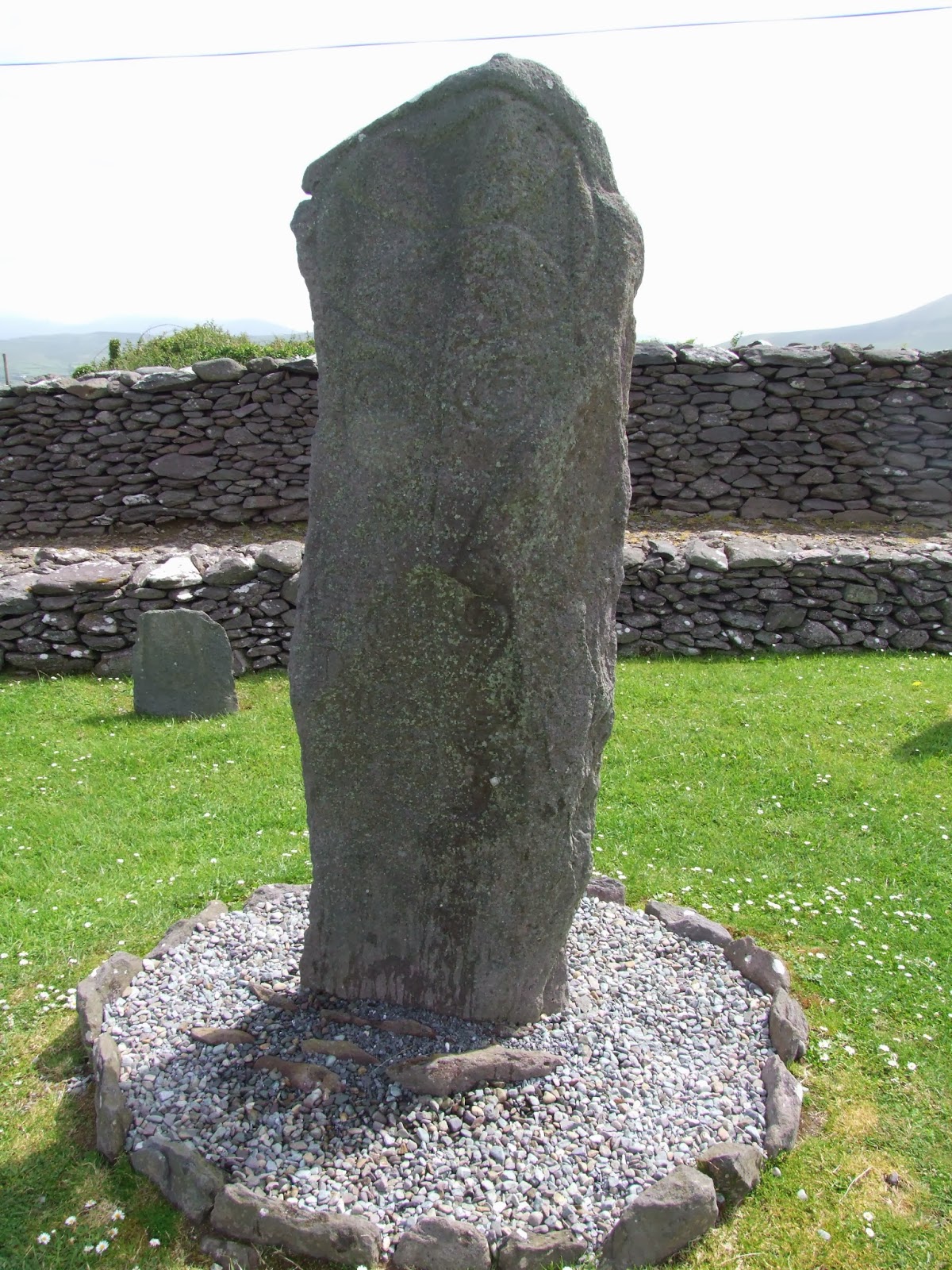
 The pool of St Catherine


The site also contains a small granite cross in a latin type shape with flayed edges. The stone is not native to the area and must have been brought in from elsewhere, possibly as part of another site. Dating the cross is somewhat difficult, but it is possible that it dates to the period of the original church and monastic settlement that still exists as part of the church today. Despite the dryness of the well, a patronal service for Saint Doulagh is still held today along with ecumenical gatherings, but no pattern has been observed here since the end of the eighteenth century.

 View of the baptistry

Lord Jesus Christ, Son of God, have mercy upon me.
The Prayer of the Heart in the Orthodox tradition
(dating back to the Desert Fathers.)

 To the rear of the baptistry

How to find it:
This is an easy site to find. Travel up the Malahide Road (R107) and you will see the church on your left. The cross stands at the entrance and the baptistry is to the right of the church.

Tuesday, April 23, 2013

Saint Barrahane’s Well, Castlehaven, County Cork.

The stained glass window of the saint in Castletownsend


The coastline of West Cork is rugged and picturesque, with beautiful scenery and the Atlantic’s roar, but nestled in Castlehaven is a secluded little bay. It takes its name from the haven provided by the bay and the castle originally built by the O’Driscoll family, but now in ruins. Its original name was an Irish name for Glenbarrahane that derived from the deep rocky glen that in times past was dedicated to Saint Barrahane (or Bearchán). The scenery in this area is impressive, with three distinctive rocks known as ‘the stags’ and a cluster of small islands. The sea around this coastline can be quite treacherous at times, but this peaceful and very sheltered bay is the perfect spot for boats and the depth of bay has been exploited in the past.

Castlehaven bay

Part of the Battle of Kinsale, which was to finally cement English rule in Ireland under Elizabeth I was fought here in 1601. The Battle of Kinsale essentially started as far back as the twelfth century, when England began a programme of attempted consolidation of the power of the monarchy. English monarchical rule relied upon the eldest child receiving all the power, wealth and title inheritance with all its benefits, but many were aware of the Irish system of chieftains where power and title were only granted through a complex series of elections involving all parts of a relevant community. Kings were also elected in the same way in Ireland (at least in theory!) and there were and could be multiple kings, even for the same area. The idea of an English monarch being a single monarch for a large area and to be granted a right by inheritance was an anathema to many Irish people, and as soon as England began it’s campaign of consolidating power to a single monarch for Ireland, the chieftains kicked back and were able to claim that they were defending their ancient rights and customs. As time trundled on, the rhetoric quickly turned to war.

The ruins of Glenbarrahane church

By the time Henry VIII was on the throne in England the whole of Europe was rife with religious and political tension and paranoia.  It was during this time that Henry was most keen to consolidate the power of the English monarchy in Ireland and he knew that the only way to break the power of the chieftains was to remove them - permanently; an idea that he carried out with exacting ruthlessness. Henry’s actions were to cause much disquiet in Ireland and by the time Elizabeth I came to the throne there were fears of uprising, but Elizabeth favoured a different route and sought to belittle and dilute the chieftains power through the plantations. But Ireland was not to remain as quiet as she had hoped. In 1590 the English experienced the most significant resistance to date from forces in Ulster under the direction of Hugh O’Neill (Aodh Mór Ó Néill). At this time the English hoped to establish a series of strongholds to strangle and thwart the Gaelic rule of the chieftains, but the Irish used ambush tactics to destroy supply lines to the garrisons, sometimes resulting in major casualties. In the end the English had to sign a humiliating truce in 1599 under the command of the Earl of Essex, but the tide was to turn on O’Neill. The Irish were very effective in their ambushes and their knowledge of the lay of the land, but in the open battle field they would be utterly humiliated and defeated. The Ulster rebellion came to a crushing defeat.

Crossing the stream to the well

By 1601 the Irish were desperate. Fears of a French or Spanish invasion of England using Ireland as a stepping stone began to surface, but the paranoia of the English on this matter was to turn into a horrifying reality.  The Gaelic Earls shook the hand of the devil, and in exchange for gold accepted the military support of the Spanish and their King, Philip III. The Spanish had little interest in Ireland, other than making use of it as a distraction for English forces while it waged its war with the Dutch elsewhere for shipping rights, spices and the delights of the East that promised glory and wealth. With England tied up in a war in Ireland it could sink it’s ships in the East without fear of repercussion and throw all its might at the Dutch. The war of distraction for the Spanish centred on the town of Kinsale. The Spanish general, Aguila, was quick to surrender to the English as he began to realise the power of the Irish chieftains was already decimated before they had even arrived to give aid. The battles and clashes were bloody and costly, and finally resulted in the ‘Flight of the Earls’ -  the end of Gaelic rule in Ireland.

 On the path to the well

Castlehaven was the site of a significant battle in this whole affair. O’Driscoll, who was Lord of the Fort at Castlehaven, was lavished with gold from the Spanish and he was quick to announce across the area that he was in full support of the Spanish forces. Baltimore, Innisherkin and Dunboy quickly followed his lead. The Spanish exploited the deep waters of the bay in Castlehaven and arranged their fleet in its shelter. The English Admiral Leveson arrived with his fleet of ships, but the wind was blowing them away from the coast. Despite the weather acting against them, they managed to sink every last Spanish ship in the bay, but arrangements had been made for a battery on the shore and Leveson's ships were seriously damaged and sent limping back to Kinsale. Due to the sinking of the Spanish ships in the bay there was no one left to return to Kinsale to join the battle there. The plan had been disastrous and in 1602 all surrendered. For Spain it was costly, but nevertheless something of a success as a war of distraction. For Ireland it was a terrible tragedy that cost many lives and by consequence hammered the nail in the coffin of the system of chieftains. On Castlehaven beach, Hugh O’Donnell joined the rest of the earls of Ireland, and fled in fear to Spain.

Saint Barrahane's Holy Well

Today the bay has little sign of such a turbulent past. The ruins of the castle are almost hidden by ivy and a small ruin of an old Church of Ireland parish called Glenbarrahane parish sits amidst ancient tombstones, slowly decaying.  From the beach up to the church ruin is a concrete path and road with a low wall, but turning into the church grounds you should be able to make out a small path through the grass towards the back of the church where there is a gate. This gate leads across a small stream and the path heads up a densely wooded and very damp glen. Across a small wooden bridge and on the other side of the glen lies the well, noticeable by the objects left at it. The well itself is very small and at quite a high elevation from the surrounding waters, shrouded in shrubs and trees. There has never been a pattern observed at this well, probably because the date of the feast day of Saint Barrahane has been long forgotten, but fishermen frequent this well to pray for safety at sea, and a tradition of using water from this well in Castletownsend parish for baptism is maintained to this day. The Church of Ireland parish, dedicated to Saint Barrahane, also boasts a fine stained glass window of the saint by Harry Clarke.

The bay

Virtually nothing is known about Saint Barrahane. There are two Saint Barrahane’s from Offaly and another from Roscommon, but the Barrahane of Castlehaven is quite different. We do not know when he was born or when he died, but we can conclude that he was of the relatively early period of Christianity in Ireland. Local records try to make a claim of a fine genealogical background, but in many other records he is simply recorded as the son of Fiachre. He does not appear to have moved from the area during his life and appears to have had no significant missionary activity, so perhaps can be assumed to have been a hermit. Whatever the truth may be, this mysterious saint found a spot of solace, peace and prayer in Castlehaven.

This area has had many significant losses to the sea in the fishing industry, many have died in truly tragic circumstances, so it seems fitting at this well to pray for the safety of those at sea by this well surrounded by nets and floats.

O God, who brought the children of Israel through the Red Sea and carried them safely through the deep as the sang praises to you, guard all your servants who make their living on the sea, and having repelled all dangers, bring them to the desired port after a calm voyage; through our Lord, Jesus Christ, who lives and reigns with you and the Holy Spirit, world without end. 
Amen.


How to find it:
From Catletownsend, take the L4218 and turn left after about a mile at the signpost for Catlehaven Castle. Travel down this road to Caslehaven until you reach the bay. Go through the church grounds (now a ruin) and enter the gate, crossing the stream and following the path up through the glen. The well is a short walk up the other side after crossing the wooden bridge


Friday, March 1, 2013

Saint David’s Holy Well, Tinakilly, County Waterford.

St David's Cathedral, Wales


Tinakilly is a small hamlet in the peaceful and secluded townland of Woodhouse (not the Woodhouse estate that Michael Jackson once tried to buy!) not far from the village of Clashmore. At it’s heart sits a beautiful holy well dedicated to Saint David, the patron Saint of Wales, whose feast day is the 1st March which marks the day of his death in 601AD.

The statue of Saint David at the well


We know a great deal about Saint David. He was from an aristocratic family in Wales and lived in the sixth century, his mother -  Non – also became a saint and he was educated and instructed in Christianity by Saint Paulinus. He is responsible for setting up a monastic settlement at Menevia, which later became known as Saint David’s in Wales where an impressive Cathedral dating from 1181 now stands and in which sits a newly restored shrine containing his relics. His monastic rule was severe. Monks were to be diligent in regular fasting, they were not to eat any kind of meat or ever allow alcohol to pass their lips,  they were not to use animals to help them plough the fields, till the land or to carry burdens, but instead were expected to do such work themselves, they were to spend every evening from sun-down to sleeping in prayer, study and in transcribing the scriptures by hand. The monks were expected to have ownership of nothing and if a monk asked to have something he considered to be his (for instance, if he asked for ‘his’ book) they would be severely disciplined. It was said at the time that David lived only off simple bread and water, but he was known as being compassionate underneath this hard, austere veneer and was well respected as a great orator. 

Saint David's shrine in the Cathedral


Saint David had a significant influence on some Irish saints, most notably Saint Aidan (aka, Mogue or Edan). He may also have had an influence on Declan as the Life of Declan contains a fleeting reference to Declan and a few of his monks travelling to Wales to meet with David and learn the art of oration in an attempt to engage Ireland’s great ‘rhetoriticians’. These are presumably the same ‘rhetoriticians’ that Patrick famously rails against in his Confessio, but sadly we nothing about them. David’s chief biographer was Rhygyfarch who compiled his Life in the eleventh century, but was keen to add to what he compiled! His compiled Life contains wonderful stories of Saint David’s birth in dramatic fashion, with lightning bolts and scores of angels and his death occurs in a likewise manner. It is Rhygyfarch who first creates an Irish link, suggesting that a Saint Elvis of Munster baptised David, but no matryrology, none of the annals, nor any saints Life contains any reference to this mysterious Saint Elvis, but it may be a mis-spelling of a derivative of Saint Ailbe. Other than the curious tale in Rhygyfarch’s Life regarding the evasion of harm from jealous monks and involving a ride on the back of a sea monster, there are no records of David ever having made the journey to Ireland after his baptism, yet from Dublin city down as far as Youghal his presence and influence is felt. In this strip of the coastline there are numerous holy well’s dedicated to him, many churches and chapels, schools and former homes and hospitals. His influence on the saints of this area in Ireland was considerable, and many of them took up his challenging lifestyle that was so influenced by the Egyptian Fathers.

Saint David's holy well


The village of Clashmore is closely associated with its own saint, Saint Mochua, and is the second most important parish in the Baronry of the Decies after Ardmore. A holy well sits at the very heart of the village and a pattern of sorts is observed on 10th February. Mochua ( a pig farmer) existed in the area dominated by Saint Declan and was deeply influenced by him, but there is no record of him meeting or being directly influenced by Saint David. He died in 631AD, having been murdered by locals. Up the hill out of the village of Clashmore, past a large pig farm and into the townland of Woodhouse sits the holy well. Access to this well is a little difficult. You have to cross a farmer’s field, then a stream in a deep trench, then clamber up the bank into a grove of hazel trees. From here you can follow the stream through the twisted trees to a peaceful spot. If you arrive at the right time, you will find the well surrounded by daffodils and in the distance you can hear quite clearly the bells of the Angelus ringing.


Very little is known about this holy well, and very few people seem to be aware of its existence. It has a sandy base through which the water bubbles up, sometimes quite dramatically. It is a circular well with a low stone wall surrounding it, flanked by numerous daffodils and with a small statue of Saint David dressed in his episcopal attire. He holds a large cross and at his feet sits his symbol of the dove (although it looks a little more like an eagle!). It is a very special place, full of both mystery and beauty. There are no offerings left, no rags on trees, just the silence and the bubbles. This is one of the most rewarding wells I have visited, in part due to its untouched and somewhat wild nature, but also because of its hidden location.  Even if Saint David’s feet never touched these shores, his influence is certainly present, an influence that likely began in this area as far back as Saint Declan.

A pig on the farm


Almighty God, who called your servant Saint David to be a faithful and wise steward of your mysteries for the people of Wales: in your mercy, grant that, following his purity of life and zeal for the Gospel of Christ, we may with him receive the crown of everlasting life; through Jesus Christ your Son our Lord, who is alive and reigns with you, in the unity of the Holy Spirit, one God, now and for ever. 
Amen.


How to find it:
From the village of Clashmore take the R671, turning right before you reach Clogh. Up the hill of this narrow lane, and past a pig farm on the left, take the bend to the flat part of the road on the right. High hedges surround the fields, but a view through a gate on the left should reveal the ditch where the stream runs and the hazel grove. Cross the field and stream and turn right up through the hazels to the well.